Raw Flesh and the Sea of Acid: Why the AwA Project Exists

Updated: Jul 21
I was born in Salvador, Bahia—a city where the sea is the oxygen of the soul. But for a long time, the sea was my greatest torturer.
From childhood through much of my adolescence, I faced a devastating skin disease. My body was a map of open wounds. I would scratch until I bled, desperately trying to tear that agony away from me. At night, the fabric of the sheet would stick to my raw flesh, and peeling it off was a ritual of pain no one should have to know so young.
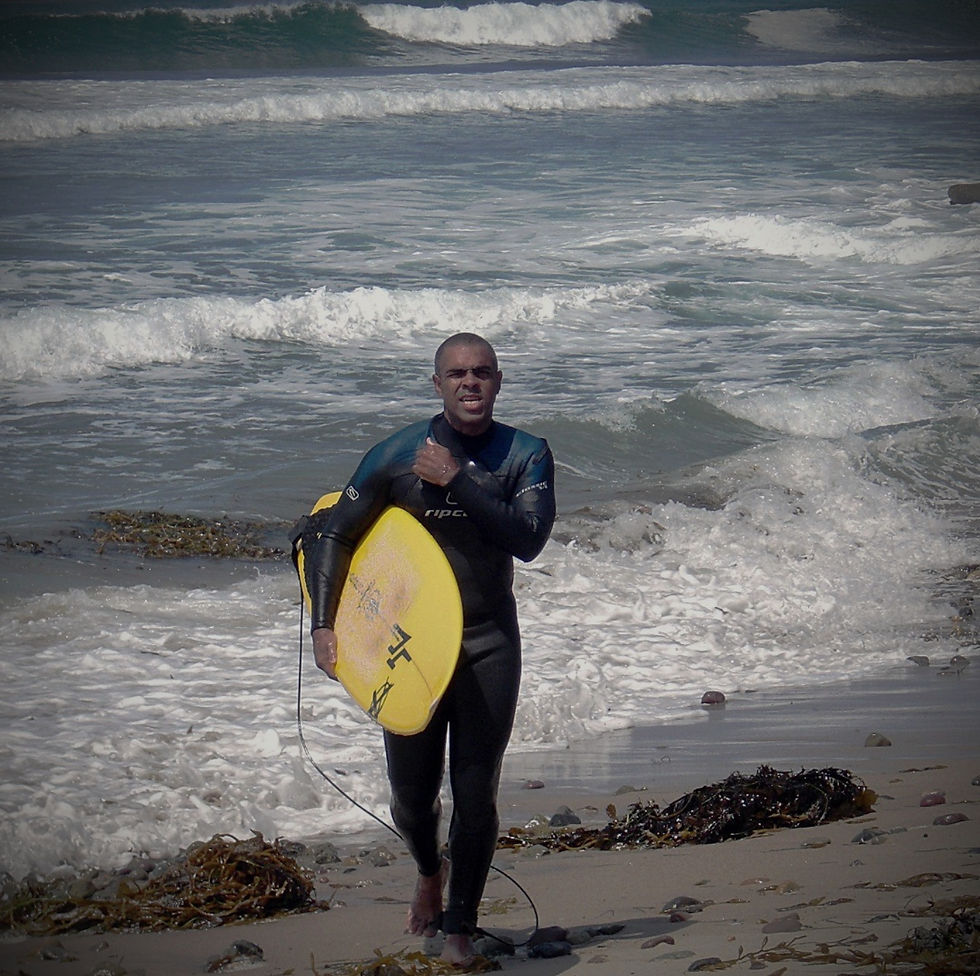
I loved to surf. The ocean was my refuge, the place where I sought my own clarity. But in critical moments, entering those waters felt like taking a bath of acid. The salt that was supposed to cleanse me burned every inch of my existence.
The Judgment, the Noise, and the Somatization of Pain
While my body burned, I had to face the eyes of the world. I saw the expressions of disgust. I felt the silent judgment of a society that worships surface-level aesthetics, performance, and perfection while entirely ignoring human essence.
Compounding this, I lived with a deep, unfiltered sensitivity. My empathy was a double-edged sword—both a profound blessing and a heavy curse. I didn't just observe people; I absorbed them. I felt their joy deeply, but mostly, I carried the crushing weight of their pain, unable to filter or manage the emotional noise around me.
Worse still, I eventually realized that this unmanaged emotional absorption was making my physical condition worse. I was literally somatizing everything I felt—turning the emotional weight of the world into raw physical pain on my skin.
The combined weight became so overwhelming that I reached my limit. I considered ending it all, seeing no way out of the physical agony or the internal overload.
The Move, the Collapse, and the Pilgrimage to Assisi
Years earlier, despite the constant friction of physical illness and emotional exhaustion, I had fought to build my foundation. I managed to graduate, earning my major in business and completing postgraduate studies in systems analysis. When I prepared to move abroad to pursue another master's degree in Canada, severe and chronic sinus issues intervened; medical experts recommended a drier climate instead, redirecting my path to California.
Yet, life in California brought its own seismic shifts. The foundation eventually fractured completely when the move was followed by the end of a four-year relationship and the sudden loss of my secure career of seven years. Overnight, the pillars I had used to define my identity were stripped away.
Seeking answers and a way out of the wreckage, I packed a bag and set out to backpack across Europe, visiting six countries in search of solid ground. But it wasn't until I reached Assisi, Italy—the ancient, deeply spiritual hometown of Saint Francis—that the real shift occurred.
Surrounded by the timeless stones of Assisi, stripped of routine and comfortable distractions, I experienced a profound internal breakthrough. In that quiet sanctuary, the accumulated noise of modern life fell away, and I reconnected with the deepest foundation of my spirituality. I realized that my heartbreak, my career loss, and my physical suffering were not random punishments; they were the friction required to crack open the superficial shell of ego and remember who I truly was.
The Awakening: From Individual Pain to Critical Thinking
It was precisely inside these intersecting battles—chronic illness, immigration, career loss, emotional overload, and the unraveling of everything familiar—that the foundation of everything I do today was forged.
I began to realize that my body and mind were somatizing not just physical friction, but the profound conflict of trying to fit into a sick, hyper-isolated system. I saw that social amnesia makes us forget who we are, tricking us into believing we are nothing more than our packaging, our status, or our flaws.
Out of sheer necessity, I had to learn how to manage my overwhelming empathy. That is where critical thinking was born. Critical thinking became my shield—a way to separate my true self from the emotional contagion of the environment, and to question the societal conditioning that demands we perform rather than exist.
That realization was the birth of Angel with Amnesia. I discovered that my core essence was entirely unreachable by acid, illness, or societal judgment. The moment I stopped fighting my own skin and learned to anchor my empathy with clear, objective inquiry, true healing began.
The Bridge: Why Inner Change and Societal Change Are Interdependent
My path as a philosopher, consultant, and holistic therapist in Los Angeles is entirely rooted in these scars. I know what it’s like to have a soul in raw flesh, and I know how loud the world’s noise can be when it tries to convince you that you have no value.
That is why the AWA Project exists.
Inner change and societal change are deeply interdependent; you cannot heal yourself while ignoring the sick culture that wounded you, and you cannot transform society without first breaking the amnesia within your own mind.
Critical inquiry was the tool that rescued me from drowning in emotional overload.
Intelligent empathy is what allows me to turn that sensitivity outward, transforming personal pain into a doorway for genuine human connection.
The Mission
The AWA Project exists so you don’t have to drown in a "bath of acid" to wake up. We are here to train your critical thinking and educate your empathy—not just for your own personal healing, but so you can return to your family, your workplace, and your community as a catalyst.
We are building a movement of local cells—autonomous groups of people waking up together, proving that connection is the antidote to isolation.
You are much better than society tells you. It is time to remember.


Comments