The Future is Bright (If You Dare to See It)

I have a challenge for you. It should be easy.
Close your eyes and name three movies released in the last 10 years that depict a future you actually want to live in.
Take your time.
Mad Max? No, that’s a desert nightmare. The Hunger Games? Authoritarian tyranny. The Last of Us? Black Mirror? If you are like most people, you are struggling to find even one. We are swimming in a cultural ocean of high-definition despair. We watch civilizations collapse in 4K resolution, and without realizing it, we begin to rehearse for the end.
The Identification Trap
Let me be clear: The problem is not that we watch these movies. Fiction is meant to explore our fears. The problem is that we watch them without Critical Thinking.
We lower our intellectual defenses and allow Identification to take hold. We don't just observe the story; we simulate the worldview. We internalize the premise that "collapse is inevitable" and "human nature is inherently savage."
Because we lack the critical filter to say, "This is entertainment, not prophecy," we allow a fictional narrative to overwrite our reality. We adopt the "Survivor" archetype—the lone wolf fighting for scraps in a ruined world.
The Reality Check: We Are Winning
Here is the truth that Hollywood refuses to script because it’s "boring": Humanity is doing better than ever before.
If you look at the data—not the headlines, but the trend lines—our trajectory is undeniably bright.
Global Poverty: Has plummeted at a rate our ancestors would call miraculous.
Literacy and Health: Are at all-time highs.
Peace: Despite the noise, we are living in one of the most peaceful eras in human history compared to the relentless slaughter of the past centuries.
We are the "Angel with Amnesia," forgetting our own triumph. We are standing at the peak of human civilization, convinced we are in the gutter, simply because the screen in front of us says so.
The Death of Empathy
This identification with dystopia doesn't just make us sad; it makes us dangerous. Fear kills empathy.
When you identify with a worldview where the future is scarce and hostile, you view your neighbor not as a collaborator, but as a competitor.
It promotes dehumanization: We start categorizing people as "threats" or "resources" rather than human beings.
It justifies atrocities: History shows that when a group believes their survival is at stake, they can justify horrific cruelty.
By uncritically absorbing these narratives, we are training ourselves to turn off our compassion in preparation for a disaster that isn't happening.
Dystopia as Internal Metaphor
This is where Critical Thinking changes everything. When we stop identifying with the fear, we can finally hear the real message.
These movies are not predicting the year 2050; they are mirroring our current spiritual and psychological decay.
The "Wasteland" isn't a prediction of climate change; it is a metaphor for our current spiritual dryness.
The "Zombie" isn't a biological virus; it is a symbol of our dehumanization and mindless consumption.
By acknowledging this, we stop preparing for an external apocalypse and start addressing the internal collapse that is already happening. This is a less painful process to progress. We don't need to manifest a physical war to learn the value of peace; we can learn it by healing our own minds today.
Rise of the Builder
When we use Critical Thinking, we shift from the "Survivor" mindset to the "Builder" mindset.Hope becomes a strategic tool. It is the ability to see a path from here to a better there.
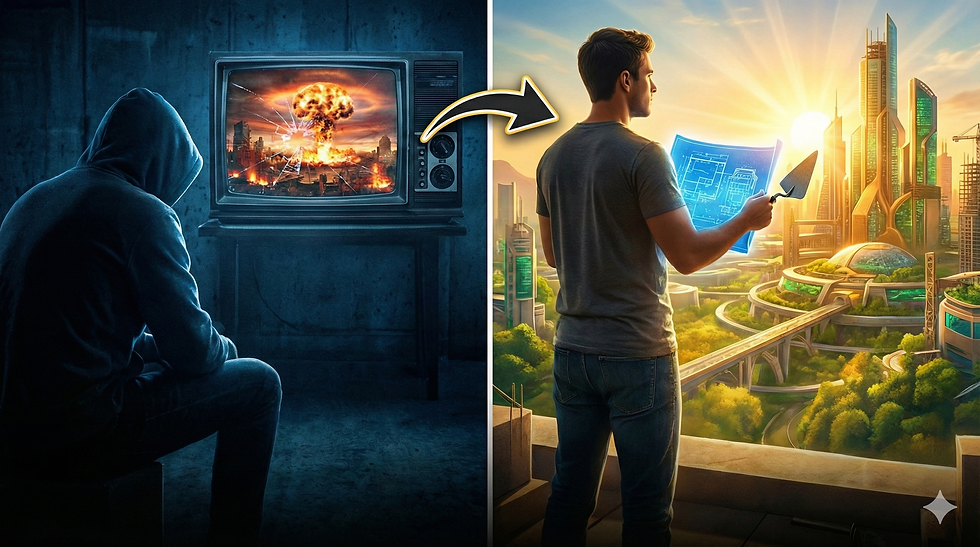
The Survivor waits for the world to end.
The Builder decides what kind of world is about to begin.
The future is not a threat; it is an opportunity we are currently building. The next time you watch the world end on screen, smile. Recognize it as a ghost of the past we are leaving behind. Then, close your eyes and imagine the world you are going to build in its place.
The Builder's Manifesto
I REFUSE to rehearse for the apocalypse. I reject the narrative that humanity is a virus and the future is a graveyard.
I CHOOSE to see the Renaissance. I acknowledge the darkness, but I do not worship it. I see the cracks in the world not as signs of the end, but as openings for the light.
I AM A BUILDER. Where the Survivor sees a threat, I see a challenge. Where the Cynic sees a competitor, I see a collaborator. The future is not a destination. It is my creation.
Comments