The Fear of War and the Birth of a New Consciousness: How Not to Let Panic Take Over

Updated: May 17
In recent days, I have observed something that concerns me more than the events themselves: the way fear has been colonizing entire hearts. The news about Iran arrives as a collective tightness in the chest. War — that old acquaintance of humanity — once again looms like a ghost, making us believe, often, that the end is near.
But history shows us the opposite. We have been at the abyss countless times, and we have always found our way back. Not by chance, but because, in the midst of chaos, there are always those who refuse to surrender their own lucidity.
In my work with the Angel with Amnesia project, I start with an image that gives the book its title: we are like angels who have forgotten their own nature. We have lost the memory of who we truly are — connected beings, part of a whole much larger than the ego can perceive. This amnesia makes us believe in separation, in competition, in fear of the other. And the crisis we are experiencing, whether geopolitical or existential, is actually a symptom: the symptom of a birth. The emergence of a new consciousness arises precisely when the old ego — individual and collective — can no longer handle reality.
The problem, of course, is that births are painful. And the question that remains is: how do we maintain sanity while this transformation takes place?
I have a practical answer, built over the years from what I call, in the book, the tools of active empathy and critical thinking. They are small choices, but they make all the difference — and they speak directly to what we are experiencing now.
1. Filter Your Mental Diet
Critical thinking begins with what you let in. In the first chapter of Angel with Amnesia, I talk about "The Garden of the Mind" and how the avalanche of information that assails us daily, instead of enlightening us, often blinds us to what truly matters: our ability to imagine a different future. If you spend three hours a day scrolling through war feeds, you're not informing yourself — you're intoxicating yourself. I know this because I've been on that side, and I learned the hard way that excessive exposure to panic does not prepare us for reality; it only empties us, robs us of our ability to act with clarity, and makes us hostages to an anxiety that serves no one.
My proposal is not to shut myself off from the world, but to consciously choose how we relate to it. Set aside 15 minutes a day to learn the essentials about what's happening. The time that remains — time that was once consumed by passive despair — can be reinvested in what is within your reach. Not to ignore the pain of others, but to avoid wasting your energy where it cannot become action. Tend to your routine, yes, but also tend to those around you. Strengthen your community. Cultivate conversations that humanize, not those that fuel panic. Because it is from these small pockets of lucidity that collective responses are born when the storm arrives.
2. Practice Humanization
One of the most effective weapons of fear is the dehumanization of the other. And it does not happen by accident. We are constantly educated for it. Just look at much of the entertainment industry: how many war films, action movies, and even science fiction stories present conflict as the solution, the enemy as a one-dimensional figure to be eliminated, violence as a natural and even heroic response? These narratives, repeated ad nauseam, shape our imagination. They teach us, without our realizing it, to see the other as a threat, as an obstacle, as something less than human.
In the book, I dedicate a chapter to what I call "The Virus of Separation" — selfishness understood as a silent virus that makes us forget we are all connected. And this disconnection is constantly fed by the stories we consume. Whenever we read about "the enemy" or "the other side," we are trained to see only blocs, flags, interests. But I have learned, through the practice of active empathy, that there is a powerful exercise: to imagine a mother, there in Iran or anywhere tensions are high, putting her child to sleep with the same fears I have.
When you humanize the other, the algorithm of hatred — whether media-driven, political, or social — loses its power over you. You break the amnesia of separation. And in doing so, you also break with a silent indoctrination that teaches us, from an early age, that conflict is inevitable and the other is disposable.
In the chapter on "The Awakening of the Forgotten Angel," I explore the idea that the cure for selfishness — that disease that isolates us — begins when we recognize our interdependence. And active empathy is one of the central practices of this awakening: an act of conscious resistance against everything that teaches us to dehumanize.
Hope as a Strategic Decision
I do not believe in a naive hope, one that folds its arms and waits for the world to get better on its own. The hope that moves me is a strategic decision: to keep the light burning during the storm. In the chapter "The Great Awakening of Consciousness," I suggest that we are facing a true "Big Bang of consciousness" — a movement of expansion that invites us to leave the prison of the ego and recognize that we are part of a living, pulsating whole.
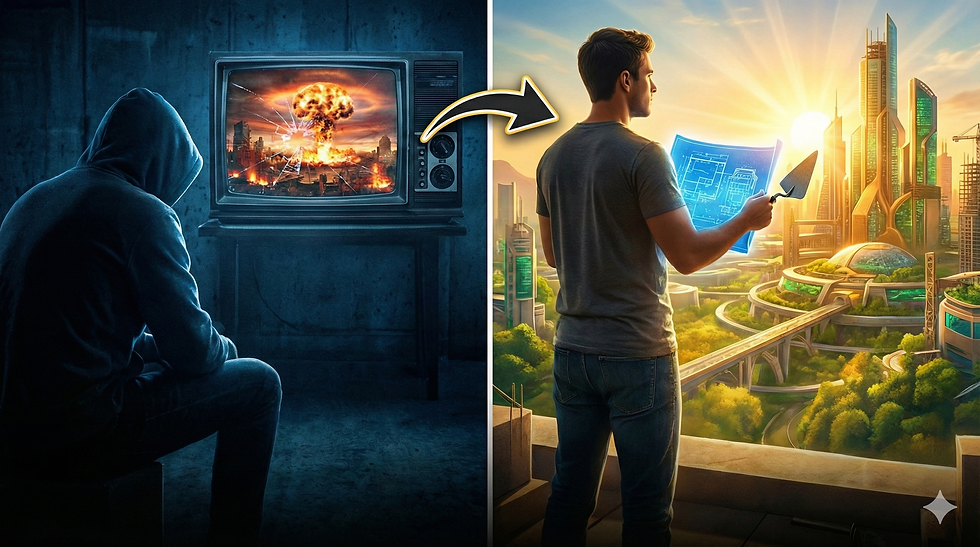
The dawn of a new civilization will not come from a grand event, but from your decision — and mine — not to be soldiers of fear anymore. It is the daily choice to act with intelligence, not reactivity. As I write in the book, intelligence is not about competing, but about cooperating; not about accumulating, but about sharing; not about fearing the other, but about recognizing in them the same spark that dwells in us.
Use active empathy and critical thinking as tools for self-acceptance and self-love. Remember: as I suggest in the final chapters of the book, the transition from ego to Self can happen through love or through pain. The choice is ours. If change is not strategic and real, it becomes mere punishment. And self-knowledge, that one, reminds us that freedom is more than comfort — it is the possibility of choosing, in the midst of the storm, who we want to be.
Let's move forward. Tomorrow is still being written. And as I wrote in the conclusion of Angel with Amnesia: the future, vibrant and full of infinite possibilities, eagerly awaits our awakening.


Comments