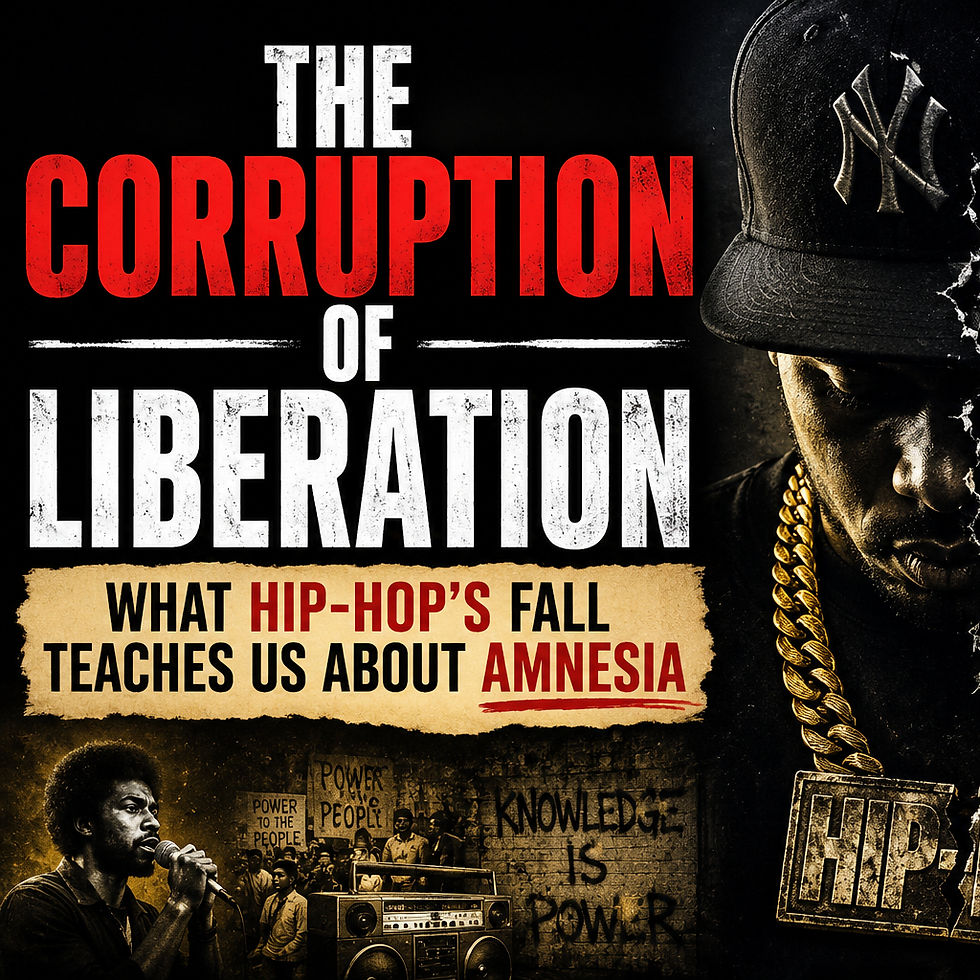
The Corruption of Liberation: What Hip-Hop's Fall Teaches Us About Amnesia

An Angel with Amnesia Case Study
Listen here:

Hip-hop was born awake.
In the burnt-out streets of the South Bronx, a culture emerged that gave voice to the voiceless. It was collective resistance in musical form—a response to state violence, poverty, and racial inequality. A community of Black, Latino, Asian, women, and LGBTQIA+ artists creating meaning from pain. This is what the Angel looks like in action: human beings using their native engineering for connection, creativity, and intelligent empathy to respond to systemic injustice. It was the default human state—collaboration and collective architecture against a system designed to break them.
But somewhere along the way, hip-hop forgot its purpose. The movement born to protest oppression became a celebration of the very values it was created to oppose. The oppressed achieved the oppressor's dream—and in doing so, perpetuated the nightmare for those who came after. This is not a story about selling out. This is a story about Amnesia—manufactured, systemic conditioning that tricks entire cultures into forgetting who they truly are. It is a masterclass in how the ego system reproduces itself through the very people it once oppressed.
The Angel
Hip-hop was never just music. It was a survival strategy. Scholars describe it as "the voice of those who counted for little, of those seeking redemption by turning pain into rhythm and poverty into art." It was "an oppositional cultural realm rooted in the socio-political and historical experiences and consciousness of economically disadvantaged urban Black" communities. It was "the ideal outlet for artists to address issues such as racism, police brutality, poverty and inequality." From Grandmaster Flash's "The Message"—which laid bare the "abject poverty" of the Bronx—to Public Enemy's massive influence on American political debate, hip-hop was a weapon of consciousness. It was "born in a climate of protest and emancipation."
The Angel represents human nature in its default, uncorrupted evolutionary state. It has nothing to do with wings or passive moral "goodness." It is the biological and psychological fact that human beings are natively engineered for deep, high-frequency connection. Our default setting is collaboration, not hyper-isolated survival. Hip-hop's birth was the Angel waking up.
The Amnesia
As hip-hop's popularity grew, so did its commercial appeal. And with that appeal came a slow, creeping transformation—a gradual forgetting of its original purpose. Amnesia rarely happens all at once. It creeps in slowly, one small compromise at a time. One song for the radio. One endorsement deal. One sacrifice of integrity for success. The system successfully ran a program to make the movement look away from its own purpose.
By the 1990s, "through the profiteering of hip-hop... music industry executives began to have control in the messages and lyrics of music produced." Black culture became marketable. White corporations figured out they could "make big bucks off of it." Scholar Tricia Rose declared: "Hip hop is not dead, but it is gravely ill. The beauty and life force of hip hop have been squeezed out, wrung nearly dry by compounding factors of commercialism, distorted racial and sexual fantasy, oppression, and alienation."
The numbers are stark. In 2025, for the first time in 35 years, no rap song appeared in the Billboard Hot 100's top 40. The genre that was once synonymous with "innovation, rebellion, and political positioning" now faces "a cycle of formula repetition and creative emptying."
Amnesia is not a personal failure, a mental defect, or an individual flaw. It is a manufactured, systemic conditioning driven by hyper-individualism, competition, and artificial scarcity. It tricks you into feeling separate, powerless, and alone. It does not mean hip-hop lost its capability; it means the system successfully ran a program to make it look away from its purpose. The mainstream personal growth market often treats individuals as permanently defective products requiring endless fixing. But the AwA Project views human evolution as a sequential process of stages. Hip-hop's corruption is not evidence that the movement was broken—it is evidence that conditioning works.
The Dream of the Oppressor
This corruption of a liberation movement is not unique to hip-hop. It points to something deeper about human nature—and about how systems of oppression reproduce themselves.
Paulo Freire, the Brazilian educator and author of Pedagogy of the Oppressed, identified this paradox decades ago. In his analysis, "in the initial stages of struggle, the oppressed do not fight for liberation, but rather want to become oppressors or 'sub-oppressors.' Their ideal is to become human, and to become human is to become an oppressor." This is the trap. The oppressed internalize the oppressor's ideology. They dream not of a world without oppression, but of becoming the oppressor. They don't want to abolish the system—they want to be on top of it.
Freire recognized that "the oppressor 'housed' within the oppressed represents an obstacle to liberation." As long as the oppressed aspire to the oppressor's position, the cycle continues. "Once they are 'promoted,' their treatment of their peers can be more brutal than their master's." The system doesn't just need to keep you down. It needs you to dream of being on top. Because when you want to be the oppressor, you never want to abolish oppression. You just want to swap places. This is the Amnesia of the oppressor's dream—and it is the most effective form of control ever designed.
The Ego System
The deeper question is: why does this happen? Why do movements for liberation so often become their opposite?
Because the system itself—the ego system—is designed to reproduce itself. It doesn't care who is on top. It just needs someone to be on the bottom. An ego-based system always needs to have a miserable category. It needs to have a category to be exploited. It's part of the nature of the egoistic system's own perpetuation.
The ego, when it is not educated by the self, creates separation. It convinces us that we are separate, that our survival depends on dominating others, that our worth is determined by our position in the hierarchy. To take advantage of someone, you must make them weak. You must make them dependent. You must make them grateful for being exploited. When the oppressed finally rise, if they have internalized the oppressor's logic, they don't abolish the system—they just swap places.
When you apply critical thinking to decode the conditioning and illusions of separation inside your own mind, you instantly comprehend the noise inside everyone else. Clearing this cognitive clutter is a sequential journey, and it is not a selfish luxury—it is a civic duty to the collective network.
The Reconnection
The solution is not to fight the system. It's to wake up from the dream of the system.
Freire's solution was to help the oppressed become fully human—which requires breaking the cycle entirely. "Liberation: not a gift, not a self-achievement, but a mutual process." This requires "rejecting the banking concept in its entirety, adopting instead a concept of [people] as conscious beings, and consciousness as consciousness directed towards the world."
Intelligent Empathy doesn't excuse the corruption. It understands it. When you see how the system works, you see the tragedy—not just the failure. You see people who forgot who they were. And you can help them remember. Critical Thinking asks the essential question: who benefits when you forget your purpose? Who benefits when a liberation movement becomes a celebration of the very systems it was created to oppose? The answers are always the same. The system. And that is exactly who you need to see.
Becoming an Architect
For hip-hop, this means reclaiming the genre's original purpose. It is necessary to rescue its original purpose. To remember that the genre was born as "a form of resistance" and that its "political lane functioned like an unofficial advocacy group to combat social ills." But this requires something deeper: a remembering of who we truly are. An understanding that we are not separate from each other, but deeply, inextricably connected.
The Progression Axiom guides this work: recognize the Amnesia—acknowledge that forgetting is a systemic program, not a personal failure. See the Ego System—understand the mechanism that needs a miserable category to exploit. Understand the Trap—recognize the dream of the oppressor and how it perpetuates the cycle. Choose Reconnection—decide to build something new instead of just fighting the old. Become an Architect—move from passive consumer to active creator of a new reality.
What If We Remembered?
What if we remembered what we were fighting for in the first place? What if we didn't just want to become the new oppressors? What if, instead of dreaming the oppressor's dream, we started dreaming our own?
For hip-hop, this means reclaiming the genre's original purpose. It means using art to wake people up, not put them to sleep. It means building community, not hierarchy. It means using influence to dismantle oppression, not to perpetuate it. For all of us, it means the same thing. What is the "hip-hop" in your life? What movement, purpose, or dream have you lost touch with? What have you sacrificed on the altar of "success"?
When you see the noise inside yourself, you see it in everyone else. The path back is not a fight—it's a remembrance. It's waking from the dream of separation and choosing to build something new. This is the Angel waking up. This is Reconnection.
The Architecture of Remembrance
The corruption of hip-hop is not a reason to despair. It is a reason to remember. Because the original spirit—the voice of the voiceless, the cry for justice—never died. It's still there, waiting for a generation of Architects to wake up and build something new.
Love your enemies. This is not weakness. It is the most revolutionary act possible. It breaks the cycle of violence. It refuses to participate in the ego's game of revenge. It creates a path out of the system.
What if we had remembered this? What if the artists who "made it" had remembered that they were not separate from the communities they came from? What if they had used their power to break the cycle, not to reinforce it?
We can't change what happened to hip-hop. But we can learn from it. And we can choose differently in our own lives. We can remember who we truly are. We can love our enemies. We can build something better. We can wake up from the amnesia.
You are an Angel. You were engineered for connection, creation, and intelligent empathy. This is your native state.
You have Amnesia. You have been conditioned to forget—to dream the oppressor's dream, to measure success by the system's standards, to feel separate and alone.
And now, you are remembering. The path back is not a fight. It is a remembrance. It is waking from the dream of separation and choosing to build something new.
What if we stopped fighting the system and started building something better? What if we stopped dreaming the oppressor's dream and started dreaming our own? What if the liberation we seek is not about winning, but about remembering?
This article is part of the Angel with Amnesia Project—a global brand and social movement dedicated to stripping away modern conditioning, defeating hyper-individualism, and returning human focus to its original, uncorrupted state through Intelligent Empathy and Critical Thinking. We believe that true change comes not from fighting the old system, but from building a new one—and that the first step is remembering who we really are.


Comments